St. Francis is known by many as the Patron Saint of Animals. You don't have to be Catholic to relate to St. Francis. I'm not. But I find myself praying to him when an animal is in need of comfort or healing.
My memories of this day harken back to New York City, and The Cathedral of St. John the Divine, on the upper west side of Manhattan. This magificient structure is the largest gothic cathedral in the western hemisphere. On the Feast of St. Francis (a/k/a The Blessing of the Animals) the great bronze doors would open and a red carpet would be unfurled down the nave. Then the procession of the animals would begin with the largest animals (an elephant, then a donkey). Both the handler companions and the animals wore garlands of fresh flowers. The Paul Winter Consort played in the background, and the Cathedral Dancers went up and down the aisles. The procession ended with a handler carrying a white mouse on a small, red velvet cushion.
Many of the hundreds of observers brought their animals to be blessed by the priests, so there was often a cacaphony of sounds in the background, mingled with the music reverberating off the stone walls. This annual occasion remains one of my fondest memories of my home town. In later years (since animal caretakers had to be deployed to clean up any droppings) they did away with the red carpet. Alas, that did take away from some of the pomp of the occasion, but I can still see in my mind's eye the carpet unfurling, and the handlers in their beautiful white robes garlanded with flowers, with the great and small creatures with whom we share this wonderful web of life.
Friday, October 4, 2013


Monday, August 12, 2013
Cats & Renal Disease
My Porter was diagnosed with renal failure. I thought we were at death's door, but at the advice of a friend in the medical profession, I cancelled the appointment for euthansia, and decided to let him die at home, after she assured me it's not a painful death.
I am happy to report that was more than 2.5 years ago. Did you know that renal (kidney) failure is the number one cause of death for both cats and dogs? Yet no one seems to know what can prevent it.
Subsequently, I have changed veterarians, and they changed Porter's diet. It's not unusal for him to go through periods where he doesn't seem interested in food. I have three types to give him, and of course, his favorite is the most expensive. But through trial and error I've learned a little trick about getting him to eat. It's simply this: move the food bowl to where he is and stick it under his nose. Most of the time he begins eating again. When that doesn't work, feeding him with a spoon helps. One vet tech had the same experience with her cat.
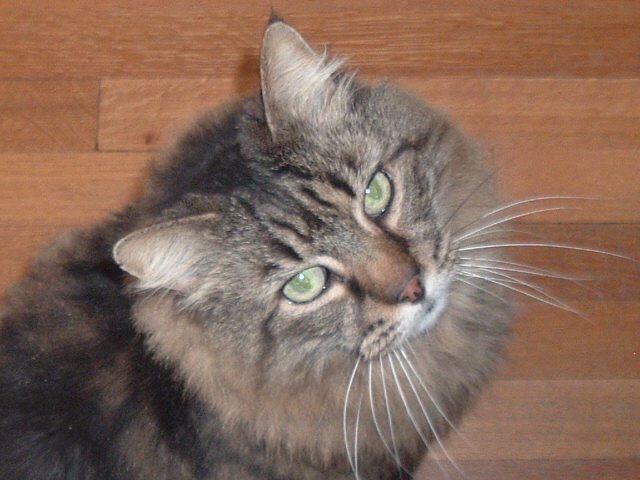
Porter is predominantly Main Coon, and he used to be a big boy. Now he has become quite slender, so it's necesssary to use any trick to maximize his food intake. His prescription food is low protein, though not everyone is in agreement about treating kidney disease that way. So he still gets his occasional treats of small amounts of tuna, and wild caught AK salmon, and he really enjoys it. To me. quality of life is more important than quantity.
Here's Porter after he sampled my lunch!

I am happy to report that was more than 2.5 years ago. Did you know that renal (kidney) failure is the number one cause of death for both cats and dogs? Yet no one seems to know what can prevent it.
Subsequently, I have changed veterarians, and they changed Porter's diet. It's not unusal for him to go through periods where he doesn't seem interested in food. I have three types to give him, and of course, his favorite is the most expensive. But through trial and error I've learned a little trick about getting him to eat. It's simply this: move the food bowl to where he is and stick it under his nose. Most of the time he begins eating again. When that doesn't work, feeding him with a spoon helps. One vet tech had the same experience with her cat.
Porter is predominantly Main Coon, and he used to be a big boy. Now he has become quite slender, so it's necesssary to use any trick to maximize his food intake. His prescription food is low protein, though not everyone is in agreement about treating kidney disease that way. So he still gets his occasional treats of small amounts of tuna, and wild caught AK salmon, and he really enjoys it. To me. quality of life is more important than quantity.
Here's Porter after he sampled my lunch!

Tuesday, August 6, 2013
Loving Lucky
The hardest part of my business is saying goodbye, particularly when a beloved animal friend has died. Some goodbyes seem as permanent as death - e.g., when Zora (a Great Dane puppy) and her Mom moved back east. So while I was tearful the day I said goodbye to Zora, I knew she would have a happier life on a farm in Vermont.
Then there's Lucky - an older rescue dog who definitely wiggled his way into my heart. First, I cared for his feline friend, Scarlett. Then, Lucky was rescued from The Pixie Project, and was added to the family. So I began to walk Lucky twice a week, year round, in chilly rain, summer sunshine, and everything inbetween. When I had time, I took him to Mt. Tabor, where he got to sniff new smells, while I reveled in nature.
Walking Lucky was the highlight of many a week. His Moms and I jokingly referred to him as the "Mini Poopster." Although small in size, he stopped to poop more times on our walks than any dog I've known.
Change is always happening, even when we are not aware of it. I had grown so used to seeing Lucky and Scarlett twice weekly (and when their family was away.) I was happy for them when I learned that there were moving from their condo to their first house. But I was sad that my twice weekly walks with Lucky were coming to a halt. It's not the loss of income that I mourn - but rather I had developed deep affection for both Lucky and Scarlett - and would no longer be seeing them on an ongoing basis.
 For now, I am experiencing Lucky withdrawal. I am thankful Lucky & Scarlett are still enjoying life, but there's no denying the aching hole in my heart.

Then there's Lucky - an older rescue dog who definitely wiggled his way into my heart. First, I cared for his feline friend, Scarlett. Then, Lucky was rescued from The Pixie Project, and was added to the family. So I began to walk Lucky twice a week, year round, in chilly rain, summer sunshine, and everything inbetween. When I had time, I took him to Mt. Tabor, where he got to sniff new smells, while I reveled in nature.
Walking Lucky was the highlight of many a week. His Moms and I jokingly referred to him as the "Mini Poopster." Although small in size, he stopped to poop more times on our walks than any dog I've known.
Change is always happening, even when we are not aware of it. I had grown so used to seeing Lucky and Scarlett twice weekly (and when their family was away.) I was happy for them when I learned that there were moving from their condo to their first house. But I was sad that my twice weekly walks with Lucky were coming to a halt. It's not the loss of income that I mourn - but rather I had developed deep affection for both Lucky and Scarlett - and would no longer be seeing them on an ongoing basis.
 For now, I am experiencing Lucky withdrawal. I am thankful Lucky & Scarlett are still enjoying life, but there's no denying the aching hole in my heart.
Yelp: what can you believe?
I am one among the many business owners annoyed about the power of Yelp, and their review filter. Although I have been operating my business in Portland for more than 9 years, the last review that Yelp shows is from 2011, which probably leads some to assume I am no longer in business.
Recently, one of my fabulous clients wrote a lovely review for me on both Yelp and Angie's List. Angie's accepted it without question. Her Yelp review, after a day or two, got dumped with the all of the others into my "filtered" wasteland. So only two reviews appear, and all of the others have "disappeared." Hopefully, folks know to click on "Filtered" to get the whole picture.
Are you aware of all the controversy around Yelp? If a business pays to advertise, they will resposition the reviews. Suddenly, good reviews will reappear, and the bad are filtered. For those of us who refuse to cave into that type of extortion, we are in review limbo.
There is only one review of my business that deserved to be filtered - from someone who expected me to undergo a criminal background and FBI check before I even met him - which I declined to do. With more than 99% of my clients indicating their trust in me at first meet - this was a red flag for future trouble.
How has Yelp gained so much power? More importantly, why hasn't there been (successful) legal action to stop this?
I used to research Yelp reviews before patronizing a business. Not any more.
What has your Yelp experience been? Feedback appreciated!
Recently, one of my fabulous clients wrote a lovely review for me on both Yelp and Angie's List. Angie's accepted it without question. Her Yelp review, after a day or two, got dumped with the all of the others into my "filtered" wasteland. So only two reviews appear, and all of the others have "disappeared." Hopefully, folks know to click on "Filtered" to get the whole picture.
Are you aware of all the controversy around Yelp? If a business pays to advertise, they will resposition the reviews. Suddenly, good reviews will reappear, and the bad are filtered. For those of us who refuse to cave into that type of extortion, we are in review limbo.
There is only one review of my business that deserved to be filtered - from someone who expected me to undergo a criminal background and FBI check before I even met him - which I declined to do. With more than 99% of my clients indicating their trust in me at first meet - this was a red flag for future trouble.
How has Yelp gained so much power? More importantly, why hasn't there been (successful) legal action to stop this?
I used to research Yelp reviews before patronizing a business. Not any more.
What has your Yelp experience been? Feedback appreciated!
Friday, August 2, 2013
Greyhounds: A Breed Apart
Greyhounds are dogs, for sure. But they are in a class of their own. They are the fastest dogs on the planet. However, they are sprinters, not endurance runners. They run after prey, but it is the thrill of the chase. They are not natural born predators. They vere more towards catch and release, vs. catch and kill. They have been mummified in tombs of Egyptians. They have been revered by aristrocracy throughout the ages. There is something both etheral - and feral about them. When I see their elongated faces and beautiful brown eyes, I am reminded of the graceful beauty of deer.
While I have cared for other greyhounds in my nine years of petsitting Pdx, I haven't known one quite like Leo. It has taken time for him to get to know me and trust me. I've been walkng him five days a week for the past few months. Now he does his "happy dance" when I show up. Then he runs for one of his toys, pounces on it, and chews. I am so happy to observe his playful side because when he was a runner at the track he didn't have toys and didn't have a life that included play. Rather, he and the other dogs were stacked on top of each other in fairly small pens. They were treated well enough because they had utilitarian value. But it's unlikely they knew love. Now he has a great Mom who dotes on him.
Yesterday I was dismayed because heading out the door Leo's foot got caught, and he cried out. It was an accident, and I felt terrible. It bled a little, but not a lot. So I took him on a shorter walk than usual; the day before I had given him a lot of extra time at Mt. Tabor Park. When we returned, I asked him to lay down, which he did. I then gently dabbed at his foot with a tissue and warm water, and gave him a biscuit. He remained perfectly still. He gave me several licks. It was the first time he had kissed me, and I knew it wasn't because of the treat. He simply understood I was trying my best to help him.
 Most greyhounds, like Leo, have a difficult time being alone. His way of stalling a return to his condo is to lay down on the grass in the middle of a walk.
Greyhounds are affectionate, inquisitive dogs, who crave the company of people. Now that it's summer, garage sales begin on Fridays. Last week there were two in his neighborhood. By taking him along after our walk he captured the admiring attention of neighbors, which he enjoyed. He is inquisitive, and as a sight hound, simply looked at what was on the tables. Sometimes, he's lucky enough to get the attention of both people and other dogs. I am glad to add some variety to his weekdays. It feels like we are both teachers for each other.

While I have cared for other greyhounds in my nine years of petsitting Pdx, I haven't known one quite like Leo. It has taken time for him to get to know me and trust me. I've been walkng him five days a week for the past few months. Now he does his "happy dance" when I show up. Then he runs for one of his toys, pounces on it, and chews. I am so happy to observe his playful side because when he was a runner at the track he didn't have toys and didn't have a life that included play. Rather, he and the other dogs were stacked on top of each other in fairly small pens. They were treated well enough because they had utilitarian value. But it's unlikely they knew love. Now he has a great Mom who dotes on him.
Yesterday I was dismayed because heading out the door Leo's foot got caught, and he cried out. It was an accident, and I felt terrible. It bled a little, but not a lot. So I took him on a shorter walk than usual; the day before I had given him a lot of extra time at Mt. Tabor Park. When we returned, I asked him to lay down, which he did. I then gently dabbed at his foot with a tissue and warm water, and gave him a biscuit. He remained perfectly still. He gave me several licks. It was the first time he had kissed me, and I knew it wasn't because of the treat. He simply understood I was trying my best to help him.
 Most greyhounds, like Leo, have a difficult time being alone. His way of stalling a return to his condo is to lay down on the grass in the middle of a walk.
 Greyhounds are affectionate, inquisitive dogs, who crave the company of people. Now that it's summer, garage sales begin on Fridays. Last week there were two in his neighborhood. By taking him along after our walk he captured the admiring attention of neighbors, which he enjoyed. He is inquisitive, and as a sight hound, simply looked at what was on the tables. Sometimes, he's lucky enough to get the attention of both people and other dogs. I am glad to add some variety to his weekdays. It feels like we are both teachers for each other.

Wednesday, July 17, 2013
Small Dogs v. Larger Breeds
As I was walking Beanie today (adorable, small Pomeranian-Poodle) these thoughts came to mind.
While large dogs and small are all part of the same biological pool, there are big differences -- not just in size. If you want a dog who can be easily well trained, who will listen to your commands, and who will make you top dog in his or her eyes, you want a larger breed, like a Labrador. They are lots of terrific large breed dogs.
Smaller breeds:
 They have longer life spans than the larger breeds. They eat less (so the food bill is less). In case of danger, a small dog can be easily picked up and carried. It's fun to have an animal cuddle in your lap. Because of their independent, spunky personalities, they can be quite funny! They don't eat much, they eliminate less, so there's less to pick up. And, they often maintain a cute "puppy" like appearance into adulthood.
Are you a fan of small or large dogs? I would love to hear from you.
While large dogs and small are all part of the same biological pool, there are big differences -- not just in size. If you want a dog who can be easily well trained, who will listen to your commands, and who will make you top dog in his or her eyes, you want a larger breed, like a Labrador. They are lots of terrific large breed dogs.
Smaller breeds:

Are you a fan of small or large dogs? I would love to hear from you.
The Thundershirt Works!
Whoever invented The Thundershirt is brillant -- and by now, probably wealthy. It is basically a piece of soft material that wraps snuggly around an animal's torso. It is the swaddling effect that gives both human babies and other animals comfort, and eases their fears.
On 4th of July this year, two Westies wore it, at my recommendation. These siblings love to bark. They are not leash trained, so they pull like crazy. The Thundershirt descreased the barking by 98% - though they still went ballistic when a skateboarder sailed by, barking at other dogs ceased. They were a bit easier to walk on leash, and overall, calmer. I've witnessed this working successfully on about a half dozen animals, and don't know of any failures.
Now there's a Thundershirt for cats. Since my cat has a difficult time with the 4th (as most animals do), and he doesn't need further stress ( he was diagnosed with renal disease 2.5 years ago), I decided to try it. The effect it had on my kitty was nothing short of amazing. He became such a mellow fellow I was able to clip his front nails for the first time. He also became super affectionate and cuddly. I plan to put it on him the next time we go to the vet since he loathes traveling in his carrier.
The company offers a 45 day money back guarantee; Petco, 30 days. It comes in small, medium and large.
www.thethundershirt.com

On 4th of July this year, two Westies wore it, at my recommendation. These siblings love to bark. They are not leash trained, so they pull like crazy. The Thundershirt descreased the barking by 98% - though they still went ballistic when a skateboarder sailed by, barking at other dogs ceased. They were a bit easier to walk on leash, and overall, calmer. I've witnessed this working successfully on about a half dozen animals, and don't know of any failures.
Now there's a Thundershirt for cats. Since my cat has a difficult time with the 4th (as most animals do), and he doesn't need further stress ( he was diagnosed with renal disease 2.5 years ago), I decided to try it. The effect it had on my kitty was nothing short of amazing. He became such a mellow fellow I was able to clip his front nails for the first time. He also became super affectionate and cuddly. I plan to put it on him the next time we go to the vet since he loathes traveling in his carrier.
The company offers a 45 day money back guarantee; Petco, 30 days. It comes in small, medium and large.
www.thethundershirt.com

Subscribe to:
Posts (Atom)